Hallo all, and welcome, finally, to the next edition of the Early Bird Extra! As you may have noticed, I've been out of action for the last few weeks. This was thanks to me getting through to the second round, and subsequently the final, of the Wettbewerb für Interpreten zeitgenössischer Blockflötenmusik (Competition for the interpretation of contemporary recorder music) in Darmstadt, Germany, over the weekend. The preparation really did take all of my energy, particularly as I'm usually a purely early musician. But it was a great experience! And, of course, it provides me with an excellent topic for today's issue.
The competition itself had not been held before; it was being put on in honour of the 80th birthday of Gerhard Braun, an esteemed recorder player and composer. I did not know any of Herr Braun's music, but I had to learn quickly; the first round required submission of a recording of his Drei Epigramme (Three Epigrams) for tenor recorder, a work which showcases many of his signature techniques, particularly the blurring of the barriers between recorder and vocal sounds. I had only one month to learn the piece, which I submitted on December 31, the day of the deadline!
And two weeks later, I was in. Exciting! Except that I suddenly had a lot more music to learn. For the second round, I chose to play Shinohara's 1968 work Fragmente (originally I was going to play Berio's Gesti, but came to the conclusion that I didn't have sufficient time to prepare it) to accompany the set piece, Bass Burner (1994) by Pete Rose. I had played Fragmente before, though it still needed work, but the Rose was not a difficult piece; it's in a kind of fast-swing jazz style, and having played jazz sax in another life, it was pretty straightforward for me.
There were nine of us in the second round (there were supposed to be ten, but one had to drop out due to illness), representing England, France, two from Austria, two from Germany, Holland, Switzerland, and of course Australia. The judges were Johannes Fischer, from Darmstadt; Karel van Steenhoven, from Karlsruhe; Dörte Niensted, from Bremen; Nik Tarasov, from Basel; and Gerhard Braun, from Stuttgart. I have to admit, those names meant, and still mean, pretty much nothing to me. But then, like I say, I'm not regularly a contemporary player!
I unfortunately don't really know what the other players were like in that round - I was too nervous, and too focussed on my own pieces, to listen in - but though I didn't think I played superbly, I did play well enough to make it into the final five the next day! I received some positive comments on my interpretation of the Rose, and though nerves got the better of me in the Shinohara, my interpretation must have at least come across enough to impress the judges. I was really not expecting to make it through, and was very surprised when I was the last of the five announced!
The final was the following day (not much preparation time), and I had prepared, more or less, Außer Atem (1996) by Moritz Eggert, Voice of the Crocodile (1988) by Australian composer Benjamin Thorn, and the set piece by Braun, Wegmarken (2009). The others in the final were Marion Fermé (France), Caroline Mayrhofer (Austria), Susanne Fröhlich (Germany), and Cornelis van Dis (Holland). Susanne was the only one I had heard of personally; actually, the fact that she was there somewhat daunted me, as I knew of her as a consummate professional, and as a contemporary specialist.
I was on last, so I spent my day preparing rather than listening to the other performers. As for my performance, I felt that I played well under the circumstances. As is quite typical of me, I played musically, and certainly with every bit of energy I had, but not perfectly. Admittedly, the Braun and the Thorne suffered thanks to spending so much time and energy preparing Außer Atem, so though my nerves were pretty steady on the day, the lack of preparation probably showed. And Außer Atem, by any stretch, though true to its name (Breathless), was far from perfect.
So I wasn't surprised that I didn't win anything, though I did get some lovely comments from people who felt that my performance deserved third place! But interestingly, the jury decided not to pick a winner, instead awarding two second places and a third; the two seconds went to Susanne and Cornelis, the third to Caroline. Having not heard Cornelis, I assumed that he would have to be very good to be considered at the same level as Susanne; indeed, I had heard that he'd been a recent competition winner, which suggested as much.
The winner's concert that evening, though, surprised me. Cornelis performed Wegmarken and Ishii's East-Green-Spring (1991) which, in my opinion, though very exact technically, were incredibly, incredibly dull. His interpretation of the Braun in particular lacked many of the subtleties Braun wrote into the music, with slight changes of timing and mood, and very precise articulation; I actually heard Braun speaking to him about these after the concert. This bothered me in that I thought I could do better, though I admit, I felt that I didn't on the day.
Caroline was a clear place-getter, in my opinion. She played Contour (2001) by Sohrab Uduman in the concert, a piece with a pre-programmed electronics setup providing various effects by stepping on a pedal. The piece sounds amazing, and she played it flawlessly so far as I could tell. But admittedly, the work, while impressive, is not difficult, and it was no doubt the step up to the next level of repertoire in terms of technical requirement that set her apart from the other two. Still, I was impressed, and this was one of the two pieces I enjoyed most that evening.
Susanne played Seascape (1994) by Romitelli, for a Paetzold contrabass with amplification and digitally enhanced acoustic, and Austro (1992/2001) by Tedde. In all honesty, I was blown away by her performance. Austro is all about circular breathing, which I find extremely difficult, but which she pulled off seamlessly. Seascape, my favourite that evening, is just a beautiful work, recreating the sounds of being on a sailboat, and if you closed your eyes, that's exactly what it felt like. Her performance was utterly professional, and perfectly executed.
So that begs the question: why didn't she win a clear first place? Well, I'm not entirely sure, but I can think of two possibilities. First, Susanne tended towards works that created an effect, rather than those based on a musical line, and while brilliant in themselves, this perhaps limited the variety, and may have played against her given Braun himself tends toward more structured musical works. Second, and more likely, she was substantially older and more experienced than the rest of the group, and probably not who the competition was really aimed at; I suspect that the jury thought it was unfair to award a first prize to a professional against a field of students, and that awarding her first prize might discourage less experienced contestants from entering next year.
And yes, there may well be a next year! They are planning to make it an annual competition. So now that I've seen how the whole competition thing works (this was my first competition outside of uni), and know how much work needs to be put in, I will definitely be back for more next time, and searching for other competitions to enter too!
Though, I admit, I would prefer to find some early music ones. When it comes down to it, that's really more my thing.
Thursday, March 8, 2012
Monday, February 20, 2012
Hiatus
Hello everybody!
Apologies that my blog has been offline for a little while; I took it down to do some work on improving it, and then had no time, because I'm preparing for a competition at the beginning of March. I've put back up the posts that were there, and rest assured, I'll be back up and running next month!
Until then, adieu!
Apologies that my blog has been offline for a little while; I took it down to do some work on improving it, and then had no time, because I'm preparing for a competition at the beginning of March. I've put back up the posts that were there, and rest assured, I'll be back up and running next month!
Until then, adieu!
Friday, February 3, 2012
On the Sources: Geminiani
Many players of early music these days rely on the word of their teachers and on listening to a lot of recordings for their understanding of style. There is of course nothing wrong with this; most good teachers have done a lot of the hard research themselves, and any ensemble worth its mettle has a wealth of knowledge behind its interpretations. But there comes a time when that no longer suffices; perhaps your teacher isn't so knowledgeable in a certain area, perhaps you can't find an ensemble whose interpretation you find appealing. Or perhaps you have reached a level at which you feel uncomfortable relying on the interpretations of others, and you're looking for the knowledge to strike out on your own, and to find your own meaning behind the music.
Having reached this general conclusion, there are two options for your further education, assuming you're not taking a university course requiring you to do specific readings - which, of course, would be a highly recommended starting point if that option is available to you, but which will inevitably also come to an end at some point. The first option would be to read some of the modern works on interpretation. There are many in English, many by highly respected performers and scholars, including Bruce Dickey, Bruce Haynes, and Frederick Neumann, just to name a few - I won't go into the details here, but I expect to review some of their titles in the near future.
These works are useful, because they collect together a lot of the treatises of the period, translate them where necessary, discuss them, and to an extent interpret them as well. But there will also be times, whether for academic reasons, due to uncertainty about interpretations, or simply to go into more detail, when you may want to go to the original sources yourself. Sometimes this will mean relying on the translations of others - most treatises are originally in French, Italian, or German, with only a handful in English. But on some occasions, the originals were in English. And in these cases, it's often possible, and desirable, to go back to the original.
One such treatise is Francesco Geminiani's The Art of Playing on the Violin, published in London in 1751. It's readily available in a facsimile edition - a direct copy of the original, which is surprisingly readable once you realise that f and s look just about the same in old English. Editions such as the one I have linked to provide only the original text, with no introductions by modern scholars or interpretive notes on each page. This can be a positive or a negative, but one thing is for sure: it saves you an awful lot of money! If you're comfortable enough to tackle the bare bones, you can get them for a steal.
So, let's talk a little about this particular treatise, starting with some context. I was lucky enough to have a lecture on the interpretation of his treatise from the magnificent Peter Walls, a Corelli scholar in New Zealand, so much of this comes from him. Geminiani was Italian, studied under Corelli, one of the greatest violinists of the period, lived in France for some time, but spent most of his later life in London.
This mobile life, among other issues, causes a number of issues of interpretation in itself. Let's have a little think about this.
Upon reading his Wikipedia article, one might assume that, having learned from Scarlatti and Corelli, Geminiani's style was thoroughly Italian. But it is well-known that he was absolutely obsessed with French style in the later part of his life, and his later compositions reflect this change, though the Italian style of Corelli, which Geminiani championed as his student, remained in vogue in England. What does this mean for our interpretation? Well, it means that with regards to style, we have to take it with a grain of salt, and interpret his suggestions using the knowledge we already have.
Very little of Geminiani's treatise is actually text: only nine pages, in fact, the rest being musical examples and exercises, the text primarily acting as explanation for them. Many of the explanations are quite technical for violinists - where to place your fingers in particular exercises, for instance - but three sections in particular may be of great interest to everyone. One of these does deal with something for the violinists, specifically how to hold the instrument; another is a table of ornaments, including detailed descriptions, not only of how and when to execute them, but of their emotional meaning.
But I will begin with the third, which is actually at the beginning. He start by saying that the goal of the violinist, and indeed of the art of music, is to 'rival the human voice', adding that those who use their instruments to produce other sounds, or who are unnecessarily flashy or showy, belong to the realm of 'legerdemain' - that is, deception, or trickery. He says that it is our job as musicians not only to please the ear, but to 'express sentiments, strike the imagination, affect the mind, and command the passions'. This is a central message of many period authors, but Geminiani's is one of the most clear and direct statements of this general philosophy of music.
The way of holding the violin is quite simply fascinating; even most specialist period violinists today do not hold it by this method, though I do know a couple in Australia who do, and in all honesty, they are among the best I know. The issue is that Geminiani asks the player to hold the violin below the collarbone, where there is seemingly nowhere for it to rest. I have heard it explained that this could be to do with the clothing of the day, that the violin could nestle in one's coat to prevent slipping. But Geminiani doesn't mention this, but simply states that holding the violin so that the neck is horizontal to the base should prevent the violin from falling.
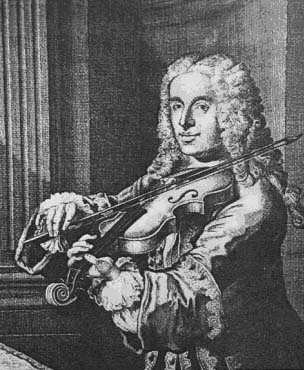
Having heard many violinists suggest that it is simply preposterous to play this way, but also having seen such technique employed to brilliant effect, and citing various pictures from the period (such as this one of Veracini), I would make this observation: the necessity for playing with this method is excellent posture. If one stands fully erect, without leaning forward, with a high chest, the violin really does sit there brilliantly. This being the case, it can tell us something generally about the way in which Geminiani expected a musician to hold him or herself: with a proud and upright posture. In this day and age, this may be an excellent exercise for us all!
(For an interesting and well-informed look at various ways of holding the violin, there is an excellent and easy to read essay by Richard Gwilt here.)
Finally, and with most relevance to all early musicians, comes Geminiani's table of ornaments, and their descriptions. There are a few fascinating things to say about the ornaments themselves. He refers to the use of piano and forte, for instance, as an ornament; similarly various devices of articulation, including staccato, separation, and even holding a note - which, he points out, is an important way of making sure the melody does not get too lost among all the beats and shakes. These, of course, are themselves described, being among the most common ornaments.
But perhaps of most interest is his lengthy description of the close shake, better known today as vibrato. Many less experienced performers of early music shy away from vibrato, having heard that it is outright wrong for the style. But Geminiani suggests that it should be made use of as often as possible. However, he qualifies this: it is for the expression of particular emotions, and should be approached differently depending on the emotion to be expressed, whether it be 'majesty, dignity ... affliction, fear' and so forth.
What I personally find most fascinating about his descriptions is the way he connects them to emotions; while some are said just to be appropriate to certain types of movement, others are directly associated with sentiments. The turned shake, for example, expresses gaiety; the superior appoggiatura expreses love, affection, and pleasure; the beat, depending on how it is performed, expresses strength, fury, anger, or resolution. He recommends practicing all of the ornaments regularly, in order to achieve the full range of musical expression.
Overall, Geminiani's treatise is of course most important to aspiring baroque violinists, and would certainly be very helpful to other early string players, but there is much in there for all of us to learn. The exercises of course only work for strings, as they assist with double-stops, left hand movement, and string changes among other things, but his descriptions of ornamentation and of music in general are fascinating on their own. Just remember when applying his teachings that he was a very international musician; if something seems wrong to you in a particular style, you're well within your rights to go with your gut. But however much practical use you do or don't get out of it, it's still worth a look!
Labels:
early music,
historical performance
Location:
Salzburg, Austria
Subscribe to:
Comments (Atom)